

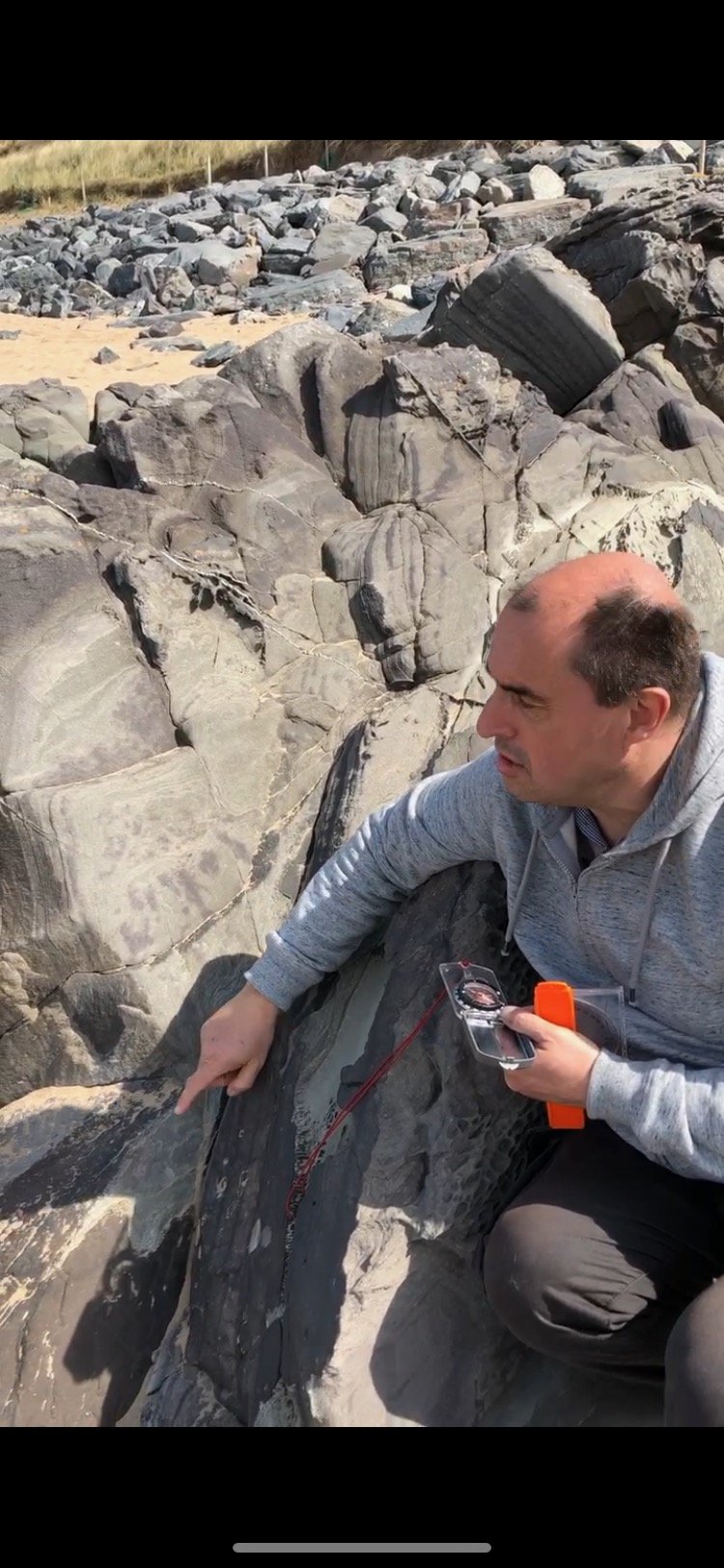
I was trained as a geological technician at the former South London College between 1982 and 1984. Like many others at the time, I was taught how to handle and prepare geological samples for oil and extraction companies, as well as for university Earth Science departments. I was fortunate to secure a position within the former Geology Department at Birkbeck College, where I gradually progressed through the ranks. During my time there, I obtained a BSc, followed eventually by a PhD, before becoming a university lecturer. I taught igneous petrology, economic ore geology, and geological mapping, much of it centered on the beautiful and geologically complex Isle of Skye. After 38 years, I left academia due to the sharp decline in student numbers following Brexit and the COVID lockdowns. Seeing the direction things were heading, I accepted an enhanced voluntary severance package — with nearly four decades of service behind me, it was probably one of the best decisions I ever made. Throughout those 38 years, I witnessed a steady decline in the skills of thin section preparation. This became especially evident as experienced thin section technicians retired and were never replaced. In fact, I often took it upon myself to prepare sections for my own PhD students because the delays in obtaining sections from their research samples had become intolerable. Now, outside academia, I have made it my mission to help preserve this essential skill, as it remains a vital tool in geology. The identification of minerals in thin section is fundamental to the classification of rocks and to understanding their petrogenesis. I founded Geology Hub UK to provide thin section preparation services for individuals, institutions, schools, colleges, and companies requiring rock sample sectioning. I also offer one-to-one training sessions for individuals interested in learning this essential thin section preparation skills. Please DM for further information.
Geology Hub
Geology Hub was lunched in 2022 as a new venture after leaving Birkbeck College, University of London, after 38 years as a Lecturer/Research Fellow.
We specialise in;
Geological microscope thin section preparation for individuals and institutions.
Geological tuition for students studying Earth Sciences at A Level and Degree Level.
Lectures on the Skye meteorite ejecta layer and igneous petrology topics to geological societies and universities, both face-to-face and online.
Training on thin-section preparation for interested individuals.

About me
I am a professional research field geologist (BSc, PhD), based in North Kent with over 40 years geological microscope slide preparation and geological field experience (geological mapping). My main geological research interests are the British–Irish Paleogene Igneous Province (BIPIP) based on the Isle of Skye and Northern Ireland and other interests include the igneous rocks of Cornwall and the Lake District.
My hobbies include petrological photography of rock samples collected and sectioned. I also enjoy exploring local geological outcrops while walking with my faithful dog companion, Stitch, in North Kent, SE England and places further afield in the UK.


Unpolarized microscope light image of the supergene copper carbonate mineral, Azurite.

“Eye of Sauron” - Crossed polarised (XP) microscope image of a recrystallised spherulite in a highly siliceous (> 85% Wt.% SiO2) spherulitic dyke found on the Heaste Road, Isle of Skye. UK.


Recrystallised quartz forming a prefect star in core of a volcanic glass spherulite, consisting of brown radial lamellar. Microscope image, XP, FOV 2mm.
Microphotograph (XP ) of tremolite crystals within a vein. Usually formed as a result of contact metamorphism of sedimentary rocks rich in dolomite and quartz.